Mankind has always been obsessed with speed. Wheels were invented to travel faster; animals were used to add more speed; animals were replaced with machines; machines are endlessly improvised. Quest for speed continues, there is always scope for improvement and machines are integral part of this quest.
Invention of wheel brought speed and benefited mankind, at same time it also created competition between wheel and humans. Some felt wheels were evil and some saw them as boon for mankind. Conflicting thoughts have continued to evolve along with quest for speed. No matter what one says everyone uses machines in some or the other form – making machines and humans companions and competitors at the same time.
Evolution has been parabolic, earlier inventions translated actions into faster or larger actions, but not on their own, they required external human force. Evolution ensured machines could operate independently; still limited by learning ability. Mankind’s quest for speed continued making machines smarter, faster and leaner. Robotics, Machine Learning, Data Science, IoT (Internet of Things), Wearables, Cognitive Implementation and Artificial Intelligence are result of evolution. Pace of evolution also has changed, today machines are used to create better futuristic machines, resulting in faster evolution with every passing generation. Increased pace has brought far looking future nearer resulting in higher industry dynamics and decision making options. Organizations competitive edge to be mainstream hinges on identifying and responding to these high potential opportunities.
While automation results in productivity, wrong automation can result in faster mistakes or automation in wrong place can result in hampered productivity. It is thus imperative to avoid common pitfalls while identifying opportunities and align enterprise resources to ensure machines are working for us and not the other way. Avoiding common pitfalls requires one to be cognizant of automation opportunity, scope and business benefit. Organizational initiatives at high level can be either strategic or tactical in nature, IT automation is no different. I have found following diagram and mapping of each initiatives to one of the quadrants to be a good start.
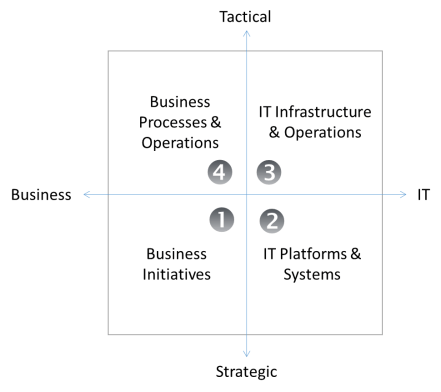
Quadrants 1 & 2 are strategic in nature with long term objectives. Quadrants 3 & 4 are tactical in nature with short term focus. Mapping organization initiatives to one of the quadrants helps in understanding realization time-frame and also the kind of automation. Following are automation possibilities.
Business Initiatives (Q1): These are enterprise transformational in nature. Business initiatives could be a new business category addition, strengthening of existing business, exiting business segment, exiting specific region, etc. Business is the entire focus and may result in IT system landscape changes. On the other hand existing IT systems might provide insights that may result in new business opportunities or changes in business landscape. Analytics, Simulation Systems and AI are common automation techniques deployed to assess new business segments. Analytics, AI, robotics, IoT, Machine Learning or business process automation platforms are commonly used in sustaining or improving existing business processes.
IT Platforms & System (Q2): These are business transformational or essential in nature. Depending on the business initiative CRM implementation for better customer management, GRC for compliance or a HRM system. The automation in the context of CRM could be chat bot, IVR, auto publishing of FAQ, lead generation, data analytics, social platform integration or robotic process automation. Automation choices may vary from simple automation scripts, robotics, screen scraping, machine learning or AI.
IT Infrastructure & Operations (Q3): These are IT focused initiatives either IT landscape transformational or business supportive in nature. DevOps, IT Helpdesk, PMO, Infrastructure Management & Infrastructure up keeping are typical examples. Simple report development, point solution developments, quick fixes, features enhancements or correction of errors are other set of business focused activities. Depending on plan of action and existing application landscape one might touch upon almost all kind of automation possibilities. Majority would be tactical in nature with some influencing or questioning IT strategy status-quo.
Business Processes & Operations (Q4): Focus is primarily on business as usual with incremental process improvements. Sometimes transformational aspects might get introduced due to business strategic priority shifts. Depending on existing processes and organizational IT maturity the automation initiatives may vary from simple automation scripts to that of a reasonably successful AI implementation.
Mapping of new business initiatives into one of quadrants is fairly simple. Mapping of existing initiatives also needs to take into account existing automation. Once the scope is determined, exact opportunities with additional depth should be identified. Additional depth provides insights into validating and verifying automation complexity and strategic returns. I found following similar quadrant system to be useful.
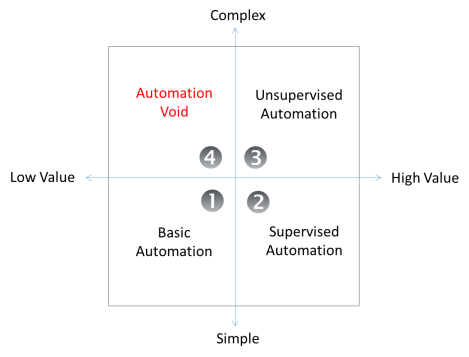
X axis refers to business value from automation and Y axis refer to automation complexity. I have found starting with strategic opportunities and then moving to tactical followed by feature level useful. Above top-down approach is generally more associated with revenue or lager cost savings. Other approach is to start from feature or functionality level (bottom-up) which is useful for identifying smaller automation opportunities that also result in smaller benefits, but benefits are seen faster. It is also important to know which part is being automated as automation of user experience is different compared to automating database compared to factory automation compared to business process. This in my opinion is a different topic for detailed write-up, will try to keep things simple in this post. Other common approach is top-down or bottom-up, irrespective to approach each opportunity should be mapped to one of the quadrants.
Basic Automation (Q1): This quadrant denotes simplest form of automation. Majority of automations in this quadrant are tactical in nature and routine simplistic in nature. These automations are more like worker ants, only without their own mind and absolutely no learning ability. Examples such as automation scripts, nightly reports, batch processing, data loading or scheduled jobs common. These are relatively easy to spot, the solution however may not necessarily result in automation as in-efficiencies are detected on existing automation. Things such as changing status of a certain data entry line item on basis of reconciliation can be done with BOTS, which can also be done by changing program’s logic.
Supervised Automation (Q2): The basic automation is monotonous in nature, it lack learning ability. Supervised automation enables systems to learn and adapt. These are capable to detecting certain actions and then mimic them. This kind of automation is very well-known in data science or machine learning, and commonly associated as supervised learning ability. Consider a process where files are sent to specific set of target folder based on name, the system is also instructed to keep files with unknown naming convention in a different designated folder. Once user moves that file to its right folder, the program is expected to learn out of that action and keep moving new files with the naming convention to the target folder. This is the simplest form of learning, in data science and machine learning there are much complex supervised learning algorithms that can start making sense out of random looking data. Identifying right candidate for this kind of automation is difficult compared to basic automation and may need engaging automation expert.
Unsupervised Automation (Q3): Next step post supervised learning is self-learning, this requires system to be much more intelligent. The decision making process of machines go beyond instructions up to extent of mimicking human thinking along with contextual and surrounding information. Machine Learning, Cognitive Capabilities and Artificial Intelligence the fields of study and implementation. This quadrant is also associated with unstructured data more compared to Q1 & Q2. Areas of face recognition, media content assessment for objectionable contents, frame-by-frame analysis of video or advanced security systems that recognize voice along with face recognition are some of the examples. One has to consult field experts for their opinion keeping an eye on ROI all the time.
Automation Void (Q4): Opportunities landing in this quadrant should be avoided. These are the potential time wasters or can have post automation incremental burden or simply not fit for automation. Example could be printing on paper, certain colour might look different post printing and may need human eyes to verify same and the select appropriate and right quality paper. If automation is still feasible, it should be justified with appropriate ROI study. Another example is in person trainer assisted experiential training, these exist by design, and implementing automation would be a mistake. It is better to stay away from automation for these scenarios, it is also best to document reasons so that other don’t waste time in evaluating opportunities again for automation.
It is also important to understand impact of automation in IT systems on organization and its people. The relation and association of organization, people and IT systems can be explained using following diagram.
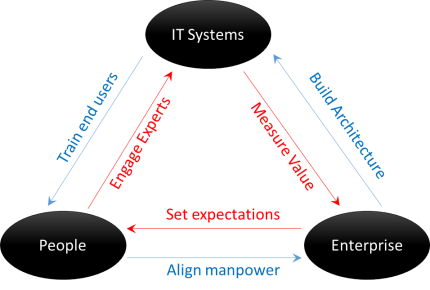
Captions and arrows in red are directional in nature. Engage Experts to ensure automation is value is determined along with feasibility. Automation in IT System should also have means for measuring the success and organizational value resulting from automation. Organization is made up of people, they should know what to expect from automation and how it’s impacting their day work.
Alignment needs are highlighted using captions and arrows in blue, these are also foundational in nature. Automation should be aligned with enterprise objectives and goals. Build architecture keeping in mind enterprise architecture. Once architecture is ready, people should know how to operate using the same, it’s important to train end users of the system. Automation can result in improved work conditions, on the flip slide it might even make person redundant. Enterprise needs be concerned of alternates and have well thought-out process to either provide alternate work assignment or succession plan for impacted users.
In summary, to automate is human nature, every active mind keeps thinking “how can I reduce my work or do it faster or do it better?”. In future automation will only increase and so are associated blunders. A structured approach is required to avoid or contain these blunders. Isolating area of automation and then choosing right automation is thus essential for enterprise survival. Harmonious automation is always concerned with enterprise and people well-being alike. These set of guidance should be considered for initial assessment and as strategic precursor for detailed deep dive analysis. Choices of implementation, benefits and workforce transformation requires a deeper analysis and thought process involving experts beyond technology experts. Let’s make sure automation is working for mankind and not the other way.
 MavenSpeak