Any IT driven automation depends on sanity of input to produce sensible output. RPA can produce consistent results as long as underlying application interfaces are not changing frequently. Certain enterprise application functions have sporadic changes, while some may change frequently. There also might be uncertainty input cases from day one such as different document formats from vendors/partners. Plan your RPA implementation accordingly.
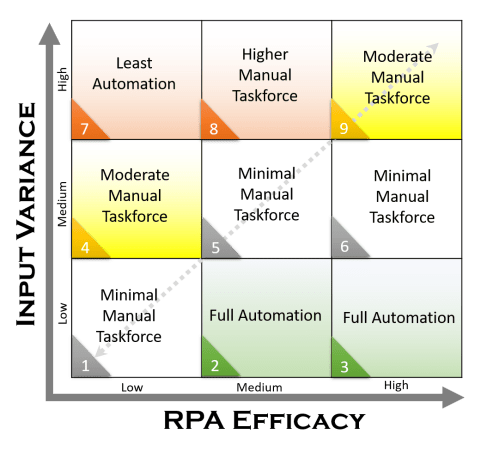
Cells 1, 2 & 3 represent business use cases that have low input variance. RPA or automation efficacy increases from cell 1 to 3. These are maximum automation representative use cases. Among these three, least automation is possible in cell 1, hence the need for minimal manual task-force.
ells 4, 5 & 6 represent scenarios having input variance that are still predictable. Example is tabular data reading from file or inputs sources with OCR. In this example, one may have to have to plan for varying rows or cells or wrong OCR. Cell 4 has least automation, hence the need for moderate manual task-force. Cell 5 & 6 have higher automation, hence the need for minimal task-force.
Cells 7, 8 & 9 represent high input variance, mostly unstructured inputs or borderline machine learning use cases. Cell 7 has least automation possibility, RPA may never be implemented for such scenarios. Cell 8 is for medium automation, hence the need for higher manual task-force. Cell 9 has highest automation possibility, hence need for moderate manual task-force.
 MavenSpeak